Why Is My Water Heater Leaking From the Bottom?
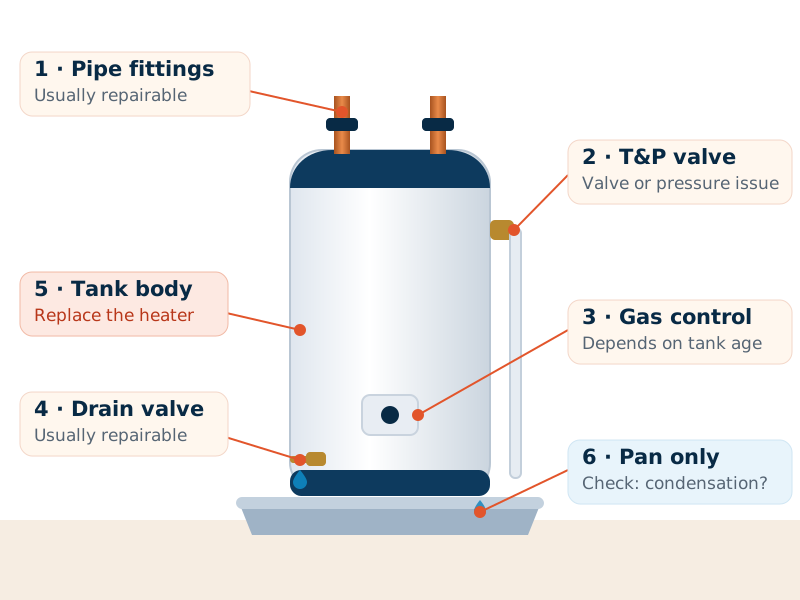
A water heater leaking from the bottom usually has one of three causes: a drain valve that won't seal, water from the T&P relief valve pipe that ends near the floor, or a tank that has rusted through. The first two are repairable. If the tank itself is leaking, the water heater has to be replaced.
Bottom leaks fool a lot of people because all water ends up at the bottom. A slow drip from a fitting on top can run down the outside of the tank, under the jacket, and pool at the base. So before you price out a new heater, take ten minutes to check where the water really starts. Our full top-to-bottom leak check covers every spot on the heater. This page focuses on water at the base.
First Steps for a Puddle at the Base
Shut off the cold water and the heat first. Then, because a bottom leak spreads across the floor rather than down a wall:
- Move stored boxes and rugs, lay down towels, and push water toward the garage door or a drain.
- In a mobile home, press on the floor near the heater closet. If it feels soft, keep your weight off it.
If you're not sure where your valves are, our how to shut off a water heater guide has step-by-step instructions for gas, electric, tankless and mobile-home closets.
The 3 Usual Causes of a Bottom Leak
1. Drain valve
The valve near the bottom is used to flush sediment. Plastic ones crack, washers wear, and hard-water grit can keep it from closing. Usually a simple repair.
2. Relief valve pipe
The T&P valve's discharge pipe runs down the side and ends a few inches off the floor. When the valve lets water out, it looks like a bottom leak. Usually a repair.
3. Rusted tank
Water seeping from the bottom seam, under the jacket or into the insulation means the steel tank has rusted through. That means a new water heater.
What else puts water at the base?
On gas heaters, the gas control valve threads into the front of the tank near the bottom, and water can weep from those threads. Gas units can also drip condensation onto the burner when the tank is full of cold water, and that dries once the tank is hot. Our guide on condensation or a real leak has two simple tests.
On electric heaters, the lower heating element sits behind a panel near the bottom. If its gasket weeps, you'll see water around the element itself while the insulation further away stays fairly dry. That's a repair (a new gasket or element). Soaked insulation all around points to the tank instead. Turn the breaker off before you open the panel.
How Do I Tell Which One It Is?
You'll need a flashlight and a few dry paper towels. Work through these in order.
- Dry the tank and floor. Wipe everything so you can see fresh water.
- Look at the drain valve. Hold a paper towel under the spout and around where it threads into the tank. Wet spout means the valve isn't sealing. Wet threads can mean a loose valve or corrosion.
- Feel the end of the relief pipe. If it's wet or dripping, water is coming through the T&P valve, not the tank.
- Check the top. Run a dry towel around the cold and hot pipe connections. Water from up there can trickle down and collect at the base. If you find it there, see our page on leaks at the top fittings.
- Look behind the access panel. On gas heaters the burner cover is at the bottom. On electric heaters there are panels over the elements. Turn the power or gas off first. Insulation soaked all around points to the tank; wetness only around an electric element points to its gasket.
Leaking From the Drain Valve
This is one of the most common bottom leaks, and one of the cheapest to fix. Local water, at about 13–16 grains of hardness, leaves calcium sediment on the tank bottom right where the valve sits. When the valve is opened, grit can lodge in the seat so it never closes fully again. Our drain valve leaking page helps you pin down the cause, and when it's time to swap the drain valve for brass, that page explains the job.
Water From the Relief Valve Pipe
The temperature and pressure relief valve is a safety part. It opens when the tank gets too hot or the pressure gets too high. Its pipe runs straight down, so the water lands at the bottom of the heater or in the pan.
Is it normal for the relief pipe to drip?
No. A steady drip means the valve is worn or something is pushing the pressure too high. Water that comes out off and on, after showers or overnight while the heater reheats with no taps open, usually points to thermal expansion with no working expansion tank. A drip while the heater sits idle points more to high house water pressure. Learn more on our relief valve leaking page.
Safety: Never cap, plug or tie off the relief valve or its pipe to stop a drip. That valve is what keeps a tank from bursting.
When the Tank Itself Is Leaking
If the drain valve, the relief pipe and the top connections are all dry, but water keeps showing up at the base, the tank is leaking. Inside every tank is a steel shell with a glass lining and an anode rod that slowly corrodes so the tank doesn't. In hard water, the anode wears out faster. Once it's gone, the steel starts to rust, often at the bottom seam where sediment sits.
What happens next with a leaking tank?
There's no safe patch for a rusted-through tank. It can also give way suddenly and dump 40 or 50 gallons, so replacement is the only real fix. If you've confirmed a tank leak, call +1 480-863-0807 and we'll go over replacement options and price before any work. Our water heater tank leaking page covers how to confirm it and what replacement involves.
Watch for Hidden Damage
A bottom leak that's been going on for a while often does more harm than the heater itself:
- Mobile homes: particleboard floors around the closet swell and go soft. Press on the floor near the heater. If it gives, tell us when you call.
- Garage platforms: many garage heaters sit on wood-and-drywall stands. A slow leak can soak the stand and the wall behind it. A metal stand and a drain pan are a better setup; see replacing a rotted stand with a metal one.
- Closets inside the house: check the baseboard, carpet edge and the wall on the other side for stains or a musty smell.
Not sure whether to fix or replace? Our repair or replace guide walks through it by age and cost, and our water heater leak repair in Apache Junction page covers how we handle every kind of leak.
Water Heater Leaking From Bottom FAQs
Does a water heater leaking from the bottom need to be replaced?
Not always. If the water comes from the drain valve or the relief valve pipe, it can usually be repaired. Only a leak from the tank itself, such as the bottom seam or wet insulation behind the access panel, means you need a new water heater.
What does rusty water around the base of my water heater mean?
Rust-colored water or rust streaks at the base, with the fittings, relief pipe and drain valve all dry, usually means the tank is corroding at the bottom seam. Rusty drips can also run down from a corroded nipple on top or a rusting drain valve, so dry everything and check the higher spots first.
Can sediment cause a water heater to leak from the bottom?
Yes, indirectly. Sediment from hard water keeps drain valves from sealing and speeds up corrosion at the bottom of the tank. With our hard water, sediment builds up faster than average, so a yearly flush helps protect both the valve and the tank. Our DIY flushing guide shows how.
Is it safe to keep using a water heater that leaks from the bottom?
It depends on the source. A drain valve drip can be caught with a bucket, or stopped with a brass garden hose cap screwed onto the spout, while you arrange a repair. Water from the bottom seam or wet insulation is different: shut off the water and the power or gas, because a rusted tank can fail without warning.
Why is my new water heater leaking from the bottom?
On a new heater, bottom water usually comes from the relief valve opening because of high pressure or thermal expansion, a drain valve left slightly open, or a drip from a connection on top. New tanks rarely leak themselves. Our guide to a new water heater leaking covers what to check and what to save for a warranty claim.
Will a drip pan stop water damage?
A drain pan helps, but only if its drain line runs somewhere safe. A pan with no drain just fills up and overflows. It also won't hold a sudden tank failure, so it buys time rather than solving the leak.