When Does a Water Heater Stand Need Replacing?
A water heater stand needs replacing when the platform is soft, stained, swollen, sagging or leaning, usually from a slow leak that soaked wood or drywall. The job means draining and lifting the heater, removing the old platform, setting a metal stand and drain pan, and reconnecting everything at the right height.
In many Apache Junction garages, the water heater sits on a box built from wood framing and covered in drywall. It works fine when it's dry. But a dripping relief valve, a weeping drain valve or years of condensation can soak into it from the top down. Drywall turns to mush, wood rots, and the box slowly gives way under a tank that weighs hundreds of pounds when full. Our page on garage platform leaks in east Apache Junction covers how this shows up in those neighborhoods.
This kind of rot is easy to miss, because it happens inside the platform where you can't see it. By the time the heater leans, the framing may be badly weakened.
Signs Your Platform Is Rotting
- Soft spots when you press on the drywall at the base or top edge of the platform.
- Brown or yellow water stains, bubbling paint or crumbling drywall corners.
- The heater leans or the gap between the tank and the wall has changed.
- A musty smell in the garage or closet near the heater.
- Gaps or cracks between the platform and the garage floor or wall.
- Pipes or the vent look strained, bent or pulled out of line, because the tank has sunk.
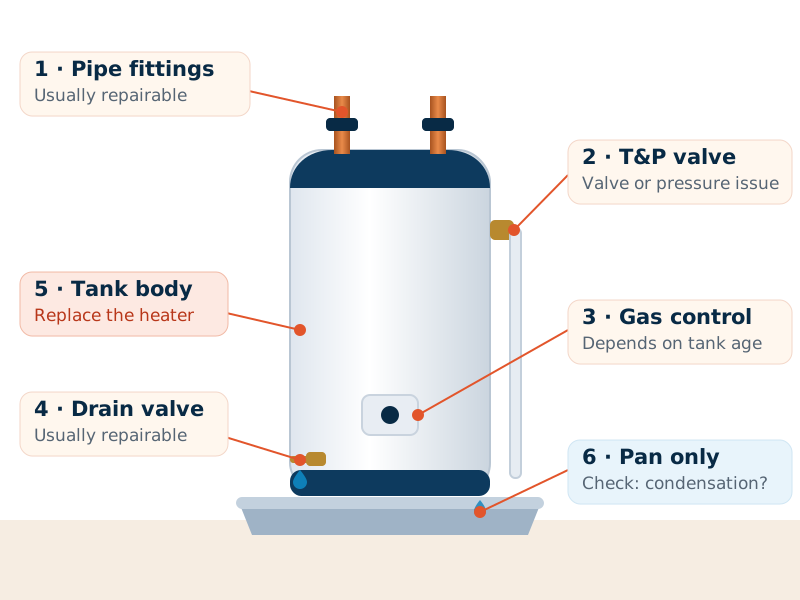
If you see any of these, find the source of the water too. A new stand won't last if the leak keeps going. Our water heater leaking from bottom guide helps you track down where it's coming from. Water that shows up only on a gas heater and dries once the tank is hot may be condensation, which our condensation vs leak page explains.
Safety: If the heater is leaning badly, don't push it back. Gas lines and vent pipes can pull apart. Turn off the gas or breaker and the cold water, keep people away, and call +1 480-863-0807. If you smell gas, leave the house and call 911 and your gas company from outside.
Why Garage Gas Heaters Sit Up High
Gasoline, solvents and paint thinners give off vapors that are heavier than air and settle near the floor. A gas water heater has a burner and a pilot or igniter, which can light those vapors.
That's why codes generally require gas water heaters in garages to have the ignition source at least 18 inches above the floor, unless the model is listed as flammable-vapor ignition resistant (FVIR). Many newer gas heaters carry that listing, but older ones and some installs don't. Ask what applies to your home, since the rules depend on the heater, the location and the local code.
Does an electric water heater need to be raised?
The 18-inch rule is about gas ignition sources, so electric heaters often sit on the floor or on a low pan. Even so, some homes raise electric heaters for easier access or to keep them out of garage floor water. During monsoon season (June 15 to September 30), storm runoff can push water under garage doors here, which is one more reason to keep the heater off the slab. We look at the setup and tell you what makes sense.
Does my water heater need to be strapped?
Straps tie the tank to the wall so it can't tip if it gets bumped or if the stand under it shifts. That matters more on a raised stand, where a tall, heavy tank sits high. Follow the manufacturer's instructions and local code for your home. We check whether straps are in place and tell you if your setup needs them.
Stand and Pan Options
Metal stand
A welded steel stand rated for the weight of a full tank. It won't rot, and air flows under it so leaks are easy to see.
Drain pan
A pan under the tank catches drips and small leaks. It should have a drain line, not just sit there filling up. See pan options.
Rebuilt platform
Some homes rebuild with a framed platform. If so, use materials that handle moisture and always add a pan with a drain.
How much weight does a water heater stand hold?
More than most people think. Water weighs about 8.3 pounds per gallon, so a full 50-gallon tank weighs well over 400 pounds once you add the steel tank itself. A stand has to be rated for that, with the load spread evenly on the floor.
A stand swap is the natural time to add a pan under the tank. Pan sizing, where its line can drain, and fitting one under an existing heater are covered on our drain pan installation page.
How We Replace a Water Heater Stand
- Find and stop the leak first. We figure out what soaked the platform, whether it's a valve, a fitting or the tank itself, and fix it as part of our water heater repair service. If water is still coming out before we arrive, our water heater leak repair in Apache Junction page covers the first steps.
- Shut everything off. Gas or power off, cold water off, and a hot tap opened. Our shut-off guide shows where each control is.
- Drain the tank. A full tank is far too heavy to lift safely. We drain it completely.
- Disconnect and lift the heater off the platform, then remove the old wood and drywall and check the wall and floor behind it for hidden damage.
- Set the new stand and pan, level and rated for the load, with the pan's drain line run to a safe spot.
- Reset and reconnect. The heater goes back on, and the water lines, gas line, vent and relief pipe are adjusted to the new height and checked for leaks.
- Refill, restore heat and test. We check the burner or elements, the vent draft on gas units and every connection.
Should I replace the water heater at the same time?
Often, yes. The heater has to be drained, disconnected and lifted anyway, which is most of the work of a replacement. If the tank is 8 or more years old, or the leak that rotted the platform came from the tank, it usually makes sense to put a new heater on the new stand. See our water heater replacement page for what a full install includes.
Do I need a permit to replace a water heater stand?
It depends on what changes. If gas piping, venting or water lines have to be rerouted for the new height, that can trigger permit rules. Our water heater permit guide covers the local rules, and you can ask us about permit requirements for your address when you call.
What Affects the Price
- Stand only, or stand plus a new heater. Pairing the two saves doing the drain and lift twice.
- How much damage is hidden. Rot that has spread into the wall or the floor plate adds work.
- Reconnection work. A new height may mean new flex lines, gas connector, vent pieces or relief pipe.
- Access. Tight closets and crowded garages take longer.
- The pan and drain line, and how far the line has to run to a safe spot.
You'll get a price once we've seen how far the rot goes. If water damage reached walls or floors, our insurance and water heater leaks page explains what policies usually cover. Most don't pay for gradual leaks, so photos and an early fix help.
Water Heater Stand FAQs
What should I do if the platform collapses with the heater on it?
Keep everyone back and don't try to lift or push the heater. If you smell gas, leave the house and call 911 and your gas company from outside. If not, shut off the main water valve and the breaker for an electric heater, or the gas if you can reach it safely. Then call us at +1 480-863-0807.
Can a water heater stand be replaced without draining the tank?
Not safely. A full 50-gallon tank weighs well over 400 pounds, and lifting it puts heavy strain on the pipe and gas connections. Draining it is the only safe way to lift the heater off the platform and set it back down.
What is an FVIR water heater?
FVIR stands for flammable-vapor ignition resistant. These gas heaters are built to keep vapors from things like spilled gasoline from reaching the burner. Many newer gas models carry this listing. It can change how high the heater needs to sit in a garage, so ask what applies to your setup.
Do water heaters in mobile homes need a stand?
Usually not a tall one. Mobile home heaters often sit in an outside water heater closet on the floor, sometimes in a pan. What matters most there is a sound floor. Particleboard swells and goes soft when wet, so press on the closet floor around the heater and look for sagging.
Can I build my own water heater platform?
Some people do, but it has to carry a very heavy load, meet the height rules for gas heaters, and hold up to moisture. A prebuilt metal stand rated for the tank is simpler and won't rot. Either way, add a pan with a drain line.
Can a drain pan go under a heater that's already on a platform?
Only by lifting the heater. The pan has to sit under the tank, so the tank must be drained, disconnected and raised first. If the platform is sound, we can set the heater back on it with a pan and drain line. If it's soft or stained, that's the time to switch to a metal stand. On a gas heater, water in the pan that dries once the tank is hot is often condensation, not a leak.