When to Repair and When to Replace a Water Heater
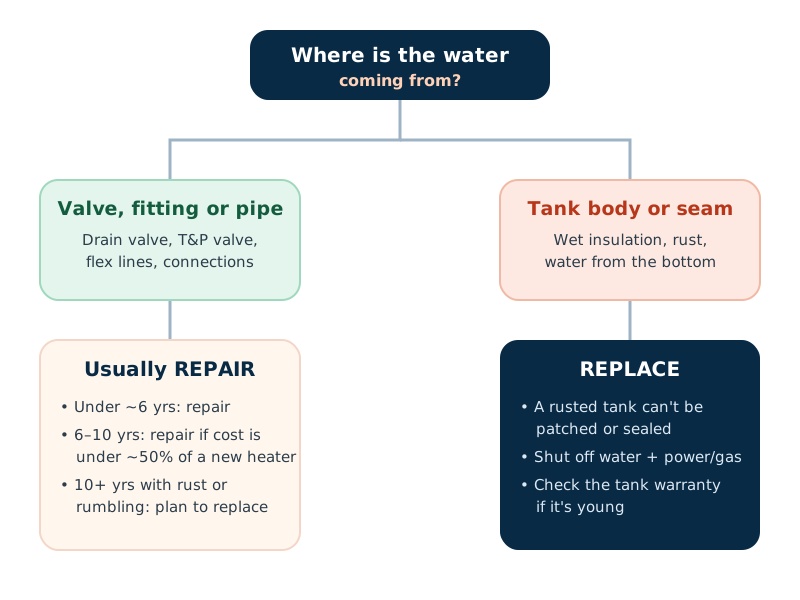
Repair your water heater if the problem is a valve, fitting, element, thermostat or pilot part and the tank is dry and under about 10 years old, unless the repair costs more than about half a new installed heater. Replace it if the tank itself is leaking, at any age, or if it's past about 10 years with rust, rumbling or rusty water. In Apache Junction's hard water, many tanks show trouble at 7–9 years.
Three Questions That Decide It
1. Where is the problem?
This matters more than anything else. A water heater is a steel tank surrounded by replaceable parts. If one of those parts failed, the heater can be fixed. If the tank failed, it can't.
| Problem area | Fixable? |
|---|---|
| Drain valve leaking or won't seal | Yes, swap for a brass valve |
| T&P relief valve dripping | Yes, new valve and maybe an expansion tank |
| Fittings, nipples or flex connectors on top | Yes |
| Electric element or thermostat | Yes |
| Pilot, thermocouple or flame sensor | Yes |
| Gas control valve | Yes, though cost matters on an older tank |
| Water from the tank body, bottom seam or wet insulation | No, replace the heater |
Not sure where the water is coming from? Our water heater leak finder walks you through it from the top of the tank down.
2. How old is the tank?
Age tells you how much life is left to protect. Tank water heaters often last 8–12 years nationally. In the East Valley's hard water, many start rumbling or leaking at 7–9 years (more on water heater lifespan in Arizona), especially if they've never been flushed. Tankless units can last 20 years or more with yearly descaling.
- Under about 6 years: repair almost anything except a leaking tank, and check the manufacturer's tank warranty first.
- About 6–10 years: repair usually makes sense, unless it would cost more than about half a new installed heater (the cost rule below).
- Over about 10 years with rust, rumbling or rusty water: plan a replacement, even if today's problem is small.
- Tank body leaking, any age: replace.
3. What does the fix cost compared with a new heater?
A simple rule many plumbers use: if a repair would cost more than about half the price of a new installed heater, replacing is usually the better buy. Here are the local numbers to measure against.
| Area figure | Average | Half of it |
|---|---|---|
| Apache Junction install or replace (Angi) | About $1,136 | About $570 |
| Phoenix-area tank replacement, installed | About $1,224 | About $610 |
| Apache Junction repairs of all kinds (Angi) | About $646 (most $422–$1,196) | Compare with the halves above |
So the halfway line sits around $570–$610, and an average repair is already past it. Valve, fitting and thermocouple jobs usually fall in the lower part of the repair range, while gas control valves and tankless parts land toward the upper part. That's why age matters so much: on an older tank, an upper-range repair often isn't worth it. These are area averages, not our prices, so test the rule with your own repair quote against a real replacement quote. Our water heater repair cost guide breaks repairs down by problem.
How to Tell How Old Your Water Heater Is
The age is hidden in the serial number on the rating label, usually a sticker on the side of the tank. Most brands code the month and year of manufacture into it, but each brand does it differently. Our guide on how to read the serial number has brand examples, or read it to us at +1 480-863-0807 and we'll tell you the age.
Tip: Write the install date on the tank with a marker once you know it. It saves guessing next time something goes wrong.
Why does age matter so much in Apache Junction?
Hard water is the local reason. At about 13–16 grains per gallon, calcium settles in the tank as sediment, which makes the burner or elements work harder and hides how worn the anode rod, the part that protects the steel, has become. Once that rod is gone, the tank starts rusting from the inside. Learn more in our Apache Junction hard water guide.
Signs It's Time to Replace, Not Repair
Water from the tank itself
A leak from the tank body, bottom seam or wet insulation behind the access panel means the inner tank has rusted through. See tank leaking.
Rusty hot water
Brown hot water, when the cold water is clear, often means the tank is corroding inside.
Loud rumbling on an older tank
Heavy sediment on a tank past 10 years usually means it's working hard and near the end.
Repeat repairs
If you've fixed it more than once in a year or two, the next dollar is often better spent on a new heater.
Signs a repair is the smart choice
- The tank is dry and the leak is at a valve or fitting
- The heater is under about 10 years old with no rust or rusty water
- Hot water problems trace to one element, thermostat or pilot part
- The repair quote is well under half the price of a new installed heater
Four Common Situations, and What Usually Makes Sense
A 5-year-old electric tank with no hot water
This is almost always a repair. A tripped high-limit switch or a failed element is the usual cause, and monsoon outages can trip the reset. An element or thermostat job usually lands in the lower to middle part of the $422–$1,196 repair range, and the tank has plenty of life left if it's dry and quiet.
An 8-year-old gas tank dripping from the drain valve
Repair it, and use the visit to check the anode rod and flush the sediment. A drain valve that won't seal is usually a sign of hard-water buildup, not a failing tank. If the anode rod is badly worn, you'll know to start budgeting for a replacement in the next year or two.
A 12-year-old tank with rusty water and a puddle under it
Replace it. Even if the puddle turns out to be a valve, rusty hot water on a tank this age usually means the inside is corroding. Spending money on parts now often just delays a bigger leak, and in a garage or mobile-home closet that leak can damage the floor and walls.
A 12-year-old tankless unit showing scale error codes
Usually repair. Tankless heaters can last 20 years or more with yearly descaling, so a scaled heat exchanger at 12 is normally a descale and a sensor check, not a new unit. See tankless water heater repair. Not sure which case you're in? Call +1 480-863-0807 and read us the serial number.
If You Do Replace It
Replacement is a chance to fix what the old install got wrong: a drain pan with a drain line, a full-size relief line, an expansion tank where needed, and a metal stand in place of a rotted wood platform. Mobile and manufactured homes need gas models listed for manufactured-home use. Our water heater replacement page covers sizes, gas versus electric, tankless and permits. For mobile homes, see mobile home water heater repair.
Still not sure? That's what we're here for. Apache Junction Water Heater Pros will find the source, tell you the age and give you both options with prices. Start with our water heater leak repair overview or call us any time.
Repair or Replace FAQs
Should I repair a water heater I plan to replace within a year?
If the fix is small, like a thermocouple or drain valve, yes. It keeps hot water going while you plan, compare quotes and pick a calm weekday for the swap. If the repair is costly or the tank shows rust, put that money toward the new heater instead. Either way, plan before the old tank floods a closet.
Is it worth repairing a 10-year-old water heater?
Sometimes, for a cheap part like a thermocouple or drain valve. If the repair is costly, or the tank shows rust, rusty water or heavy rumbling, replacing is usually better. In Apache Junction's hard water, 10 years is a good run for a tank.
What is the 50% rule for water heaters?
If a repair would cost more than about half the price of a new installed water heater, replacement is usually the better value. Using local averages ($1,136 in Apache Junction, $1,224 across the Phoenix area), that line sits around $570–$610. It's a rule of thumb, not a law, and age and condition matter too.
My water heater is only a few years old. Should I replace it?
Not before checking the manufacturer's tank warranty. Use the serial number on the label to confirm the age. Many young-tank problems turn out to be a valve or fitting, which is a repair. If the tank itself is leaking, the warranty may cover the tank, though labor is often extra. See leaks on a newer heater.
Does a gas or electric heater change the decision?
A little. Gas control valves cost more than electric elements and thermostats, so a gas control failure on an older tank tips toward replacement sooner. Electric element and thermostat repairs are usually worth doing on a tank under about 10 years. Fuel matters less than tank age and where the water is coming from.
Will a new water heater be more efficient?
Usually, especially compared with a tank full of hard-water sediment, which wastes energy heating through the scale. Compare the efficiency rating on the yellow EnergyGuide label of any model you're offered. A correctly sized tank set around 120°F, as the U.S. Department of Energy suggests, also keeps running costs down.