How Hard Is Apache Junction Water?
Apache Junction tap water typically measures about 13–16 grains per gallon of hardness, over twice the roughly 6 grains of a typical US tap. That's considered very hard. In a water heater, those minerals settle as sediment and scale, which wears out drain valves and heating elements and stresses the tank bottom. It's a big reason many local tanks show trouble at 7–9 years.
Hard water isn't a health problem. Calcium and magnesium are natural minerals. But they're tough on anything that heats water, and a water heater heats a lot of it every day. If you've noticed white crust on faucets, spots on dishes, or a water heater that pops and rumbles, you've already seen what it does.
Where Does Apache Junction's Water Come From?
Depending on where you live, your water comes from one of two main providers:
Arizona Water Company
Serves much of the city with groundwater from local wells, blended with Central Arizona Project (CAP) water from the Colorado River.
Apache Junction Water District
Delivers Colorado River water brought in by the CAP canal and treated at the Superstition Area Water Plant. It also draws on wells, and has reported about 13.5 grains per gallon at one of them.
Groundwater in the Sonoran Desert picks up minerals from the rock and soil it moves through, and Colorado River water carries its own mineral load. Either way, Apache Junction homes end up with hard water. Your provider's yearly water quality report lists exact numbers for your area.
How do I convert water hardness numbers?
Reports often list hardness in milligrams per liter (mg/L) or parts per million (ppm). Divide by about 17.1 to get grains per gallon. For example, 240 mg/L is about 14 grains per gallon.
What Hard Water Does Inside a Water Heater
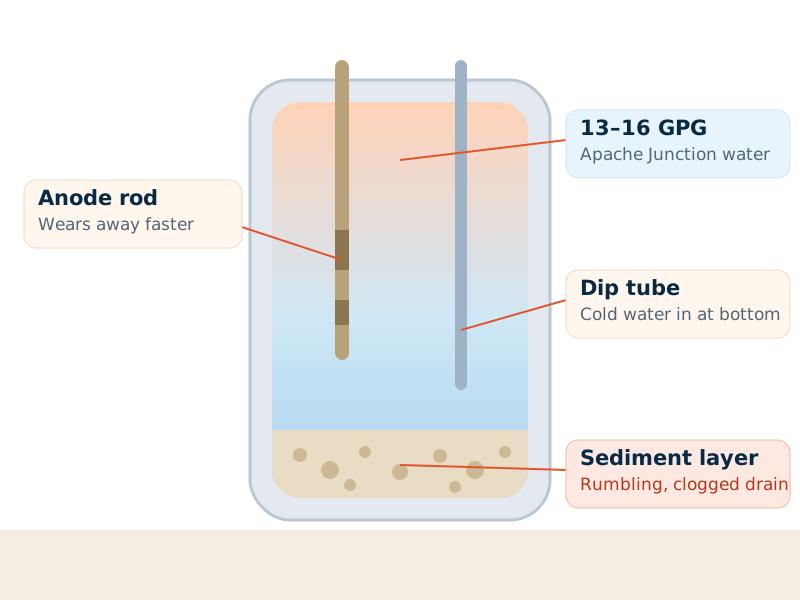
When water heats up, some of its dissolved minerals come out as solid scale. In a tank heater, that scale falls to the bottom as a gritty layer of sediment. Over time it causes a chain of problems:
- Popping and rumbling. Water trapped under the sediment boils in little bursts when the burner fires. That noise is a sign of buildup.
- Lower efficiency. On gas heaters, sediment sits between the flame and the water, so it takes longer and more gas to heat.
- Burned-out elements. On electric heaters, scale coats the lower heating element until it fails.
- Leaky drain valves. Grit keeps the drain valve from sealing after it's opened. See our drain valve leaking page.
- Weeping relief valves. Mineral crust on the valve seat can keep the T&P valve from closing tight after it opens, so it drips. More on a relief valve that keeps dripping.
- Faster tank wear. Heat trapped under sediment stresses the bottom of the tank, right where many tanks rust through.
The Anode Rod: Your Tank's Hidden Protection
Inside every tank is a long metal rod (see anode rod replacement), usually magnesium or aluminum, that slowly corrodes so the steel tank doesn't. It's called a sacrificial anode. When it's used up, the tank starts to rust instead.
Does hard or softened water use up the anode faster?
Hard water itself isn't the main thing that wears out a rod. Softened water is: it carries current more easily, so the rod is used up faster. Homes with a softener should keep a closer eye on it, and our anode page lists a checking schedule. Replacing a rod that's worn down to the core wire can add years to a tank and costs far less than a new heater. A tank that's already leaking is too late, though. Once the steel has rusted through, see our water heater tank leaking page.
Flushing: The Easiest Habit That Helps
Draining the tank through the drain valve washes out loose sediment before it hardens into a crust. With water at 13–16 grains per gallon, once a year is a sensible schedule. It's a job many homeowners can do in about an hour: our step-by-step flushing guide covers the safety points and what to do if the valve sticks. If you'd rather hand it off, we can do it on a flush visit and check the anode and relief valve at the same time.
Tip: If the heater has never been flushed and it's more than a few years old, a large flush can stir up enough grit to make an old plastic drain valve stick or drip. That's normal. A brass valve fixes it.
Do tankless heaters need flushing too?
Yes, but it's called descaling. In tankless units, scale builds up inside the heat exchanger, where it can cause error codes and temperature swings. In water this hard, plan on descaling about once a year. Our tankless water heater repair page explains how it's done, and our tankless installation page covers scale protection for a new unit. If you are still choosing a type, our tank vs. tankless comparison weighs how each one copes with water this hard.
Where Softeners and Scale Control Fit In
Water treatment is optional. For most tanks here, yearly flushing plus anode checks does the heavy lifting for little money. Whole-home softeners and salt-free scale control cost more and suit some homes better than others, and softened water can wear anode rods faster. Our post on whether a water heater needs a softener compares the options and who they make sense for.
Signs Hard Water Is Wearing Out Your Heater
- Popping, crackling or rumbling when the heater runs
- Hot water runs out faster than it used to
- Rusty or cloudy hot water
- A drain valve that drips after it's opened
- The heater is 7 or more years old and has never been flushed
Any of these is worth a call to +1 480-863-0807 before it turns into a leak. If you're weighing a fix against a new heater, see our repair or replace guide. If you're already seeing water, start with our water heater leak finder.
Apache Junction Water Heater Pros serves homes on this water, from older 85120 homes and RV parks along the Apache Trail to east-side 85119 homes off Idaho Road. Call any time at +1 480-863-0807, or see our water heater repair in Apache Junction and water heater leak repair in Apache Junction. More short answers are in our water heater FAQ.
Apache Junction Hard Water FAQs
Is Gold Canyon water as hard as Apache Junction's?
Yes. Gold Canyon is served by Arizona Water Company's Apache Junction system, so it falls in the same range of about 13–16 grains per gallon. Water heaters there face the same sediment and scale, whether they're garage tanks or the tankless units found in many site-built homes, which need yearly descaling. See our Gold Canyon leak repair page for local details.
Does hard water affect gas and electric heaters differently?
Yes. In a gas tank, sediment settles on the bottom right above the burner, so heat has to push through it, which wastes gas and stresses the steel. In an electric tank, scale coats the lower element, which runs hotter and burns out sooner. Both benefit from yearly flushing; electric owners may also notice lower element replacements more often.
Does hard water shorten water heater life?
Yes. Sediment and scale make the heater work harder, wear out valves and elements, and stress the tank bottom, so local tanks tend to give trouble a few years earlier than the national range. Flushing and anode checks win some of that time back. Our post on water heater lifespan in Arizona has the numbers.
Why does my water heater make a popping sound?
Popping usually means sediment has built up on the bottom of the tank. Water trapped under the layer flashes to steam when the burner or lower element heats it. Our post on why a water heater pops or rumbles covers the other causes and when the noise is a warning.
How can I check my own water hardness?
The easiest way is your water provider's yearly water quality report, which lists hardness for your system. If it's given in mg/L or ppm, divide by about 17.1 to get grains per gallon. Inexpensive test strips from a hardware store give a quick home reading too, though they're less precise than the report.
Is hard water safe to drink?
Hardness minerals are mostly calcium and magnesium, and hard water isn't treated as a health concern. The trouble is what those minerals do to appliances, fixtures and water heaters. If you have questions about your own water's quality, your provider's yearly water quality report is the place to look.