When Does a Water Heater Relief Valve Need Replacing?
Replace a water heater relief valve when it drips all the time, is crusted or corroded, fails a lift test, has never been tested on an older heater, or has opened after the tank overheated. The new valve must match the pressure and temperature rating and the Btu rating on your heater's label, with a correct discharge pipe.
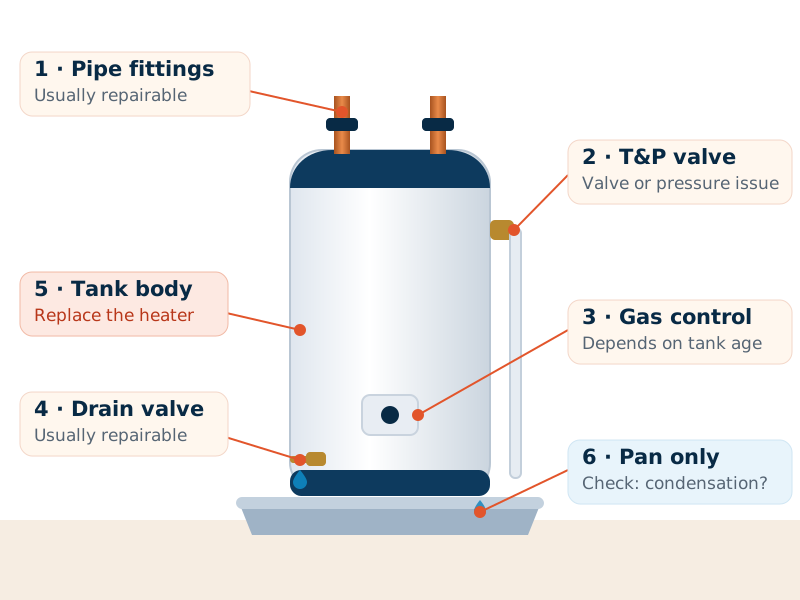
The temperature and pressure relief valve, or T&P valve, is the brass valve with a small lever near the top of the tank. It opens if the tank gets too hot or the pressure gets too high, and it sends that water down a pipe toward the floor. It's a cheap part that protects an expensive tank.
Not sure the valve is really the problem? Our relief valve leaking guide covers diagnosis: a steady drip usually means a worn valve, while water that comes out now and then usually points to thermal expansion. This page covers the replacement itself.
Safety: Never cap, plug or put a shut-off valve on a relief valve or its discharge pipe. A blocked T&P valve can't protect the tank if the thermostat or gas control fails. If the valve drips, fix the cause.
Signs It's Time for a New T&P Valve
Some valves give clear warnings. Others look fine until someone lifts the lever.
- A constant drip from the end of the relief pipe, day and night, even when no one has used hot water.
- White or green crust on the valve body or around the lever. With water at about 13–16 grains per gallon here, minerals build up on the seat until it can't close.
- A failed lift test. You lift the lever and nothing comes out, or water comes out and won't stop when you let go.
- An old valve that's never been tested. On a heater that's 8 or more years old, a valve that's sat untouched may be stuck. Replacing it is often smarter than testing it and hoping.
- After an overheating event. If the valve opened because a thermostat or gas control failed, the high heat can damage the seat. We fix the control and usually replace the valve too.
- Water at the valve threads, where the valve screws into the tank. This one needs a closer look, since it can also mean corrosion in the tank.
Can a dripping relief valve be repaired instead of replaced?
Not really. T&P valves are sealed safety devices and aren't meant to be taken apart. Sometimes a single lift of the lever flushes out a piece of grit and the drip stops. If it doesn't, a new valve is the fix.
Matching the New Valve to Your Heater
A relief valve isn't one-size-fits-all. The wrong one may fit the threads and still be unsafe. We check three things before installing a new valve.
Pressure and temperature
Most home heaters use a valve set at 150 psi and 210°F. The heater's rating label lists the maximum working pressure. The valve's setting can't be higher than that.
Btu rating
Every valve has a metal tag showing how much heat it can relieve, in Btu per hour. That number must be at least the heater's input rating, which is on the heater's label.
Probe length
The valve's sensing probe has to reach into the hot water at the top of the tank. Tanks with thick insulation often need an extended-shank valve.
Where do I find the rating on my water heater?
Look at the rating label on the side of the tank. It lists the model, the input in Btu per hour for gas or watts for electric, and the working pressure. For electric heaters, multiply watts by about 3.4 to get Btu per hour: a 4,500-watt element works out to about 15,400 Btu, so the valve tag needs at least that. On older valves the tag may be faded or missing, so the heater label is what we match to.
Tankless heaters use a pressure relief valve instead, matched to what the unit's manual calls for. Our tankless heater repairs page covers those.
Discharge Pipe Rules We Check on Every Job
A new valve won't help much if the pipe it drains into is wrong. Older homes can have relief pipes that are too small, capped, threaded at the end or run uphill. We check for those and fix them at the same visit.
- Full size. The pipe has to be the same size as the valve outlet, usually 3/4 inch, all the way to the end.
- No cap, valve or plug anywhere along its length.
- No threads on the open end, so no one can screw a cap onto it later.
- Runs downhill so it drains fully and doesn't trap water.
- Ends where you can see it, usually within about 6 inches of the floor or the drain pan, or at another spot local code allows.
- The right material. Copper or another pipe rated for hot relief water. Plain PVC drain pipe isn't rated for it.
In many mobile homes the relief pipe runs through the floor or out the side of the outside closet. That's fine when it's full size and open. We check that it isn't crushed, kinked or buried in dirt where it ends. An outdoor pipe end can also get packed with dirt or debris after a monsoon storm (June 15 to September 30), so we clear the outlet. Our mobile home water heater page has more on those closets.
How We Replace a Relief Valve
- Shut off the heat and water. Breaker off for electric, gas control to "Off" or "Pilot" for gas, then close the cold-water valve. Our water heater shut-off guide shows each one.
- Relieve pressure and lower the water level. We open a hot tap, then drain enough water that the level drops below the valve opening. On side-mounted valves that's a few gallons. On top-mounted valves it's less.
- Remove the old valve and pipe. Old valves can be tight from scale. We brace the tank so the fitting doesn't twist.
- Check the tank opening. Rust or soft metal in the threads tells us the tank may be near the end. If we see that, we tell you before going further.
- Install the matched valve with thread sealant rated for potable water, then fit a correct discharge pipe.
- Refill, test and restore heat. We refill with a hot tap open to push out air, check for drips, turn the heat back on and watch the valve through a heating cycle.
Should I replace the relief valve myself?
Handy owners do it. The common mistakes are buying a valve with the wrong Btu rating, cracking a fitting by forcing an old valve out, and reusing a bad discharge pipe. If you're unsure about any step, have it done.
What affects the cost of a relief valve replacement?
The valve itself is inexpensive, so time is most of the price. A valve seized in the tank by scale, a discharge pipe that has to be re-run to the right size, or a heater in a tight outside closet adds time. Angi reports a typical range of $422 to $1,196 for water heater repairs in Apache Junction, and a plain relief valve swap usually sits toward the low end of it. Our water heater repair cost guide explains those area averages. You'll hear the price for your valve before we start.
Why a New Valve Can Still Let Out Water
If a new T&P valve starts letting out water again within days, the valve is likely fine. The pressure is the problem. Water expands every time the heater runs. In a closed system, with a pressure-reducing valve on the main or a check valve at the meter, that extra water has nowhere to go. You notice it most when no taps are open, such as overnight or in a closed-up house.
Heat plays a smaller part. Garage and outside-closet heaters in Apache Junction sit in air near the July average high of about 105°F, which can make an already-worn valve weep but won't open a new one.
The fix for pressure is an expansion tank on the cold line, or a new one if the old tank has lost its air charge. Our expansion tank installation page explains thermal expansion and how to spot it. We check house pressure on every relief valve job so we can tell you which problem you have.
After the Job: Testing and Care
How often should a T&P valve be tested?
We recommend lifting the lever once a year, which is also what many heater manufacturers suggest. With a bucket under the pipe, lift the lever for a few seconds and let it snap back. Water should flow freely and stop when you let go. Keep hands and feet clear; the water is scalding.
What else should I check after a new valve goes in?
- The end of the relief pipe stays dry for the next few days.
- No moisture where the valve meets the tank.
- Hot water temperature feels normal (the U.S. Department of Energy suggests about 120°F for most homes).
- No new water on top of the tank. If the fittings up there drip, see our water heater leaking from top guide.
If your old valve opened because the tank overheated, the new valve is only half the job. The thermostat or gas control that let the water get too hot has to be found and fixed, which is part of our water heater repair service. And if the relief pipe is pouring water and won't stop, shut off the heat and the cold supply, then see our water heater leak repair in Apache Junction page for what to do next. Call +1 480-863-0807 any time, day or night.
Relief Valve Replacement FAQs
How long does a T&P relief valve last?
There's no fixed number. In hard water, mineral buildup on the seat is what usually ends a valve's life, and that can happen years before the tank wears out. A valve that's tested once a year tends to stay free. One that's never been touched for a decade is more likely to stick or drip.
Can I use any 150 psi relief valve on my water heater?
No. Pressure is only one of the ratings. The valve's Btu rating must be at least the heater's input, and the probe has to reach the hot water at the top of the tank. A valve that fits the threads can still be the wrong valve. Match it to the heater's rating label.
Does the relief valve pipe have to go outside?
Not always. In many homes it ends a few inches above the floor or the drain pan, where you can see it. Some homes, mobile homes especially, run it through the floor or wall to the outside. What matters is that it's full size, runs downhill, has no cap or threads on the end, and meets local code.
Should I replace the relief valve when I replace the water heater?
Yes. New heaters come with a new T&P valve already matched to the tank, and it should be used. Reusing an old valve from the old heater is a bad idea. The discharge pipe should also be checked and replaced if it's undersized or damaged.
Is a T&P valve the same as a pressure-only relief valve?
No. A tank water heater needs a combination temperature and pressure valve, with a probe that senses water temperature inside the tank. A pressure-only valve opens on pressure alone and can't protect a tank that overheats. They can look alike and share thread sizes, so check that the tag shows both a pressure and a temperature setting.